The question of "how to get around" will hit you right at the airport. Pattaya is a city with no subway and chaotic urban sprawl, and the local transport here has its own unique vibe. Let's figure out how to travel between restaurants, beaches, and hotels without going broke on your very first day, and when it makes sense to rent a bike.
Songthaews — Pattaya's Main Transport
Songthaews (often called "tuk-tuks," though technically they are pickup trucks) are open-backed vehicles with benches and a roof, serving as the city's main workhorses. In Pattaya, songthaews are what shared minibuses are to Moscow, only without a conductor and with a nice breeze.
The main rule: songthaews run on fixed routes. Almost all lines pass through the center, connecting the beach with the north and south.
How to use them
Stand by the side of the road, spot a songthaew with empty seats, and raise your hand. The driver will stop, but they won't drop you off right at your hotel's doorstep: they stick to their route. You pay when you get off — pass your money forward to the other passengers, and they pass it to the driver. They give back honest change, but make sure to keep small bills handy.
Main Routes
- Beach Road: North to south along the sea.
- Second Road: The reverse direction, running parallel to the beach.
- Jomtien — Center: Connects South Pattaya and Jomtien.
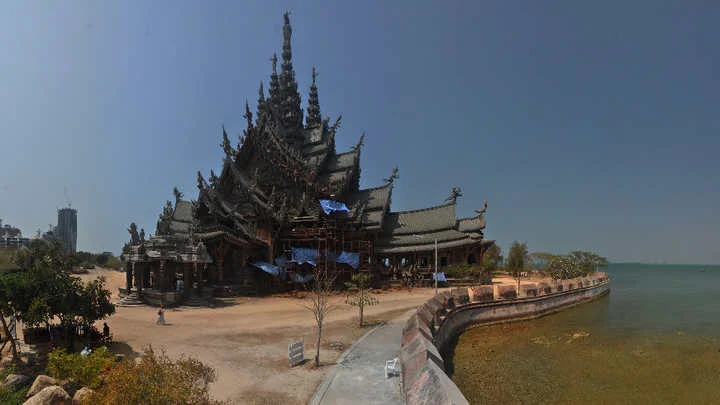
A songthaew is the cheapest way to get to attractions like the Sanctuary of Truth or to Walking Street, especially if you are staying in a more remote area.
Taxis and the Grab App
Songthaews are convenient as long as you are moving in straight lines from north to south. If you need to cross the city or carry shopping bags from your shopping trips, a taxi is a must.
Street Taxis
Hail one on the street, and the haggling begins. There are no meters; the driver sees a tourist and quotes a price 2–3 times higher than the actual rate. A typical dialogue:
- Driver: "Two hundred!" (200 ฿).
- You: "Too much, one hundred!"
- You settle on 120–150.
It's exhausting, especially if you are already tired. That's why it's better to use ride-hailing apps.
Grab
Grab is the Asian equivalent of Uber. Its main advantage is a fixed price before you even start the ride.
- From the center to Jomtien: 100–150 ฿.
- From the center to U-Tapao Airport: 800–1200 ฿.
Pros of Grab: you see the price immediately, you can choose a car (GrabCar) with air conditioning, and the driver is tracked. The downside: during rush hour, the app adds a surge pricing markup. For beginners, it's safer to choose GrabCar rather than a motorcycle taxi (GrabBike) — it's fast, but risky without riding experience.
Renting a Bike: Is It Worth It?
Pattaya is a city of asphalt surfers. The traffic is heavy, chaotic, and drives on the left. If you can confidently ride a moped, a bike gives you absolute freedom; if you can't, it's better not to learn here in real-world traffic.
Documents and Rules
To rent, you'll need to leave a deposit (your passport or cash). Legally, you need an International Driving Permit with a category "A" endorsement. In practice, rental shops turn a blind eye, but the police at checkpoints will fine you for lacking a license and for riding without a helmet.
Prices
- Automatic moped (Honda Click, Air Blade): 200–300 ฿/day.
- Larger scooter (NMAX, PCX): 400–600 ฿/day.
- Gasoline: a full tank (4–5 liters) is about 100 ฿, which lasts for 2–3 days.
A bike is a convenient way to hunt for Thai street food in the alleys where songthaews don't go. But always use a lock and never leave your helmet on the seat — someone will snatch it.
Transport Prices in 2026
Pattaya isn't the dirt-cheap paradise it was 10 years ago, but it's still very affordable. Here are the estimated prices.
| Transport Type | Price ( ฿) | Features |
|---|---|---|
| Songthaew (on route) | 10 | Cash only, fixed route. |
| Songthaew (private) | 200–400 | Negotiable. |
| Grab (car) | 60–150 | Price is fixed in the app. |
| Street taxi | 150–300 | Always haggle. |
| Moped rental (per day) | 200–300 | + gasoline. |
Prices are approximate and depend on the time of day (it's more expensive at night) and the distance.
Tips: How Not to Overpay and Get Lost
- Gasoline for your bike. You need gasohol 91 (green pump) or 95 (more expensive). Fill up at chain gas stations (PTT, Shell), not from bottles by the side of the road — they dilute the fuel there.
- Navigation. Google Maps works fine, but addresses in Thailand are confusing. It's much easier to just show the driver a pin on the map than to try and explain a street name.
- Getting between neighborhoods. If you are staying in the north (Naklua) and need to get to Jomtien, it's easier to take a ride down Thepprasit Road or just call a Grab.
- Traveling with kids and luggage. Grab is your best bet. Songthaews are cramped with bags and children, especially during rush hour.
Local transport isn't a complicated system once you know how it works. Use songthaews to feel the breeze for pennies, Grab for comfort, and a motorbike for freedom. Hopefully, these tips will help you spend less on getting around and more on tours and delicious dinners.