If you ask any tourist what they associate with Thailand, one answer will definitely be that mouth-watering, sour, and spicy aroma. Tom Yum is not just a soup; it's the true symbol of Thai cuisine and arguably the country's most famous dish alongside pad thai. Many tourists are afraid to order it: they get confused by the names or worry that their tongue will go numb from the heat. There's no need to worry. Authentic Tom Yum is all about harmony, not aggression. Let's break down what it consists of, how the "clear" and "creamy" versions differ, how to ask for "not spicy," and where to find the most genuine broth in Pattaya.
What is Tom Yum
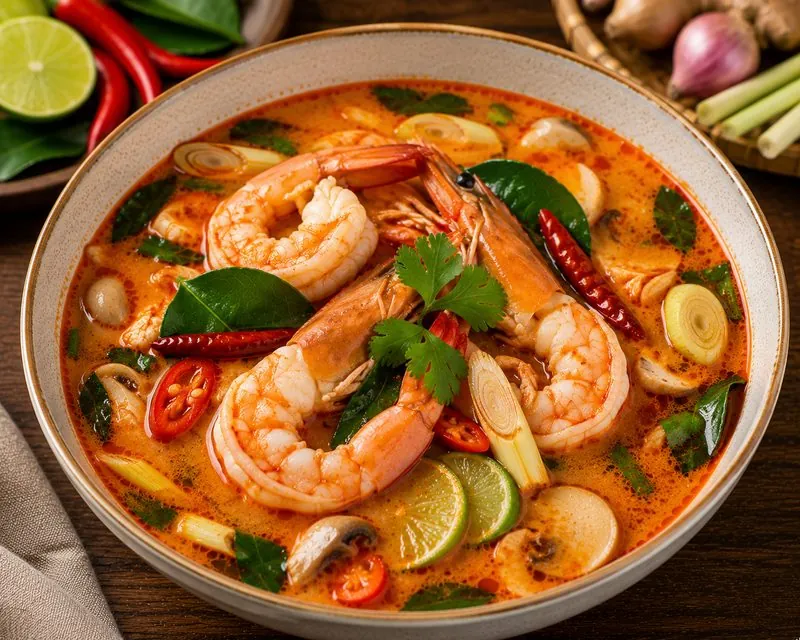
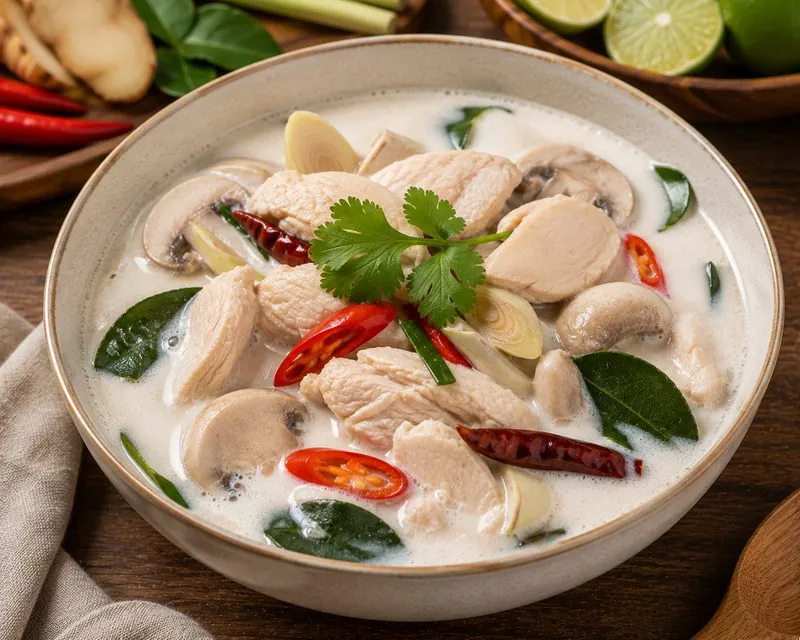
Tom Yum is a national Thai soup with a sour and spicy broth. Its magic lies in the balance of four flavors: sour (lime, tamarind), spicy (chili), salty (fish sauce), and sweet (palm sugar). It creates a complex, multi-layered bouquet that is impossible to mistake for anything else.
The base of any Tom Yum is the broth (chicken or made from shrimp shells) and the "holy quartet" of aromatic herbs:
- Galangal — Thai ginger. Woody and tart, do not confuse it with regular ginger.
- Lemongrass — gives off that distinct citrus aroma you can smell before the plate even reaches your table.
- Kaffir lime leaves — add a perfumed lemony hint.
- Cilantro roots — bring freshness.
Cherry tomatoes and mushrooms (usually king oyster or button mushrooms) are always floating in the broth. The protein is your choice: shrimp (Tom Yum Goong), chicken (Tom Yum Gai), fish (Tom Yum Pla), or a mixed seafood medley (Tom Yum Talay).
In Thailand, Tom Yum is rarely eaten as a standalone soup — it's usually served with a separate portion of steamed rice (khao), and you eat it alongside the broth like a gravy. It makes for a complete meal, especially for lunch.
Types of Tom Yum: Nam Khon and Nam Sai
This is the most important distinction when ordering. Mix them up, and you'll get a completely different experience.
Tom Yum Nam Sai (Clear)
A pure broth with no additives. The sourness and spiciness are at their maximum here, with nothing to soften them. The taste is sharp, vibrant, and "honest." If you want to feel the true tanginess of the herbs, go for this one. It's easier on the stomach but fiercer on the taste buds.
Tom Yum Nam Khon (Creamy, with paste)
Chili paste (nam prik pao) and often a bit of coconut milk or evaporated milk are added to the finished broth. The soup turns an orange-red color, becoming thick and creamy. The fat softens the heat, making Nam Khon seem much more "friendly" to the Western stomach. This is the version most frequently brought to tourists by default.
| Characteristic | Nam Sai (Clear) | Nam Khon (Creamy) |
|---|---|---|
| Appearance | Clear, dark red | Cloudy, orange-red |
| Taste | Sharp, brightly sour | Mellow, creamy |
| Spiciness | Felt much stronger | Softened by the fat |
Spiciness: How to Order Tom Yum "Not Spicy"
In Thailand, "not spicy" (mai phet) by Thai standards still means it "burns a little." Traditionally, Tom Yum is supposed to be spicy — otherwise, it's just an herbal broth. But everyone's stomach is different, and here is how to get a delicious soup without burning your esophagus.
- Mai phet — not spicy. The most reliable phrase. The Thai version of "not spicy" might still sting a bit.
- Phet nit noi — a little bit spicy. A safe bet for beginners.
- Mai sai prik — don't put any chilies in at all. The flavor will be sour, without any peppery notes.
- Coconut milk — if you order Nam Khon, it will automatically feel less scorching because the fat binds the capsaicin.
Where to Try Tom Yum in Pattaya
Pattaya has plenty of places that cook Tom Yum from a premade packet. We avoid those. We look for cafes where the broth is simmered for hours, not just stirred up from a powder.
- Local eateries where Thais eat. The main criterion is a line of locals. These are simple hole-in-the-wall spots near markets (like the Naklua Market or Thepprasit) and in residential areas. If they don't speak English, just point at your neighbor's plate. A chicken or fish Tom Yum here will cost next to nothing, and the taste will be completely authentic.
- Mid-range cafes. Fresh shrimp, good broth, clean tableware. A Tom Yum Goong here costs around 150–300 baht. For a full list of tried-and-tested spots, check out our Thai cuisine section.
- Seafood restaurants by the sea. Here, you're paying for the view and fresh lobster. A seafood Tom Yum (Talay) will set you back 350–600 baht, but the presentation and ingredients are top-notch.
How much does Tom Yum cost in 2026
Prices depend on the location: the beachfront strip is always more expensive than the inland areas.
| Place | Type | Price (baht) |
|---|---|---|
| Street vendor / Market | With chicken or pork | 60–90 |
| Local cafe | With shrimp (Goong) | 100–200 |
| Mid-range cafe | Tom Yum Goong (large shrimp) | 200–350 |
| Seaside restaurant | With seafood (Talay) | 350–600 |
* Shrimp Tom Yum (Tom Yum Goong) — from 100 ฿ at a cafe, up to 500 ฿ at a restaurant.
* Fish Tom Yum (Tom Yum Pla) — from 80 ฿.
Now you're fully armed. You know the difference between Nam Sai and Nam Khon, you can confidently ask for "Mai phet," and you won't overpay for a tourist trap. Tom Yum is your gateway into authentic Thai cuisine. Don't be afraid to experiment, try it at street stalls (where there are lots of locals and a hot blazing fire), and listen to your own taste buds. Also, be sure to check out our Thai cuisine guide to find the best spots in Pattaya.